Launch offer — valid today only

📄 Digital book in PDF · read it on your phone or print it

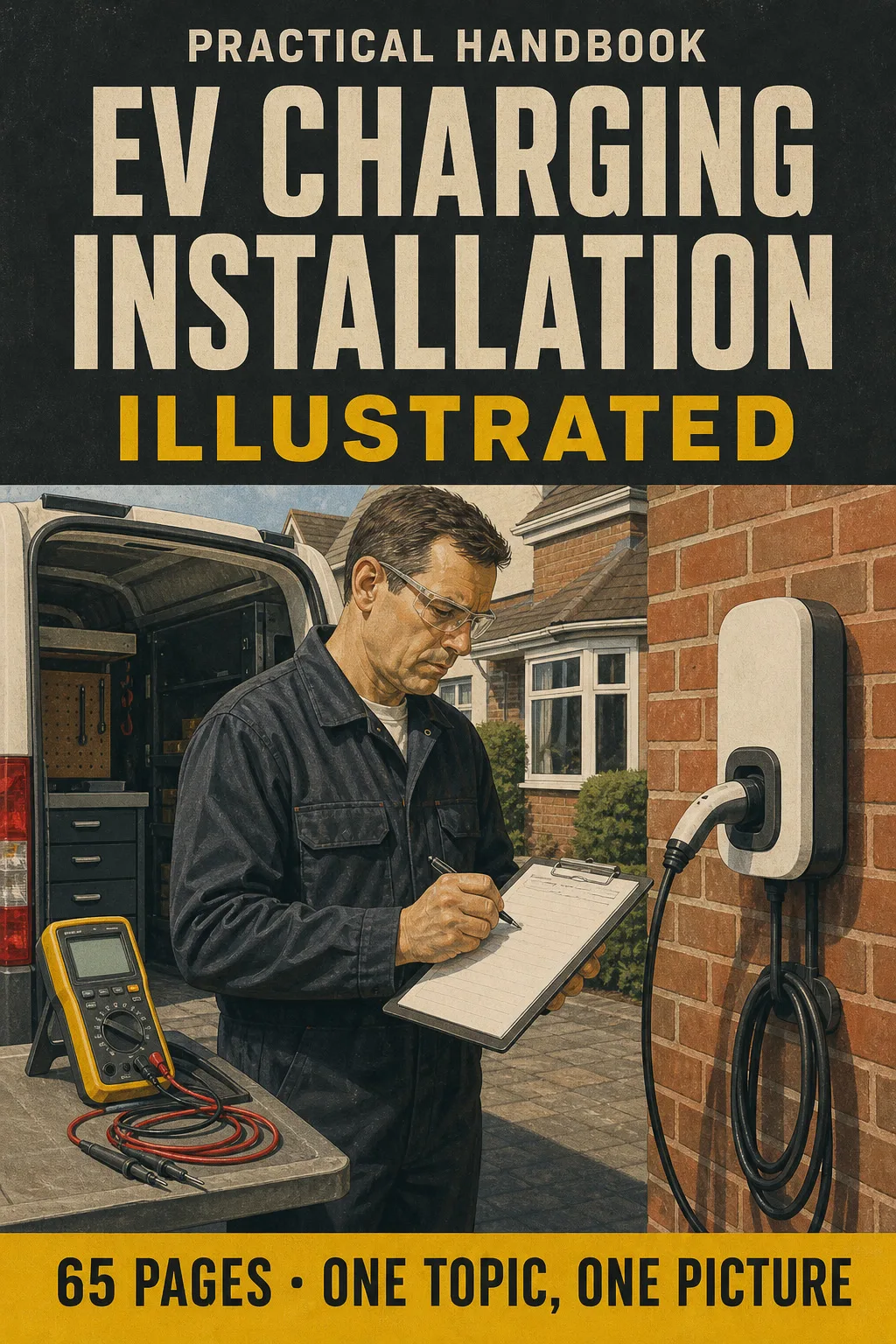
EV Charge Point Installation and the 2921-34 Exam in Drawings One Install Decision per Page

Charging modes, the control pilot, supply assessment, maximum demand, voltage drop, RCDs and DC fault protection, open-PEN earthing, testing and certification. Every topic has its own page: the drawing first, then what you need to remember. 65 illustrated pages.

START STUDYING THIS WAY

🔒 Secure checkout · PDF by email · 30-day guarantee

Every topic, its own pageEach install decision drawn, with the explanation next to it
65 illustrated pages8 parts, from the 7-step design method to the site checklist for the van
Up-to-date sourcesBS 7671 Section 722, the IET Code of Practice for EV charging and the Smart Charge Points Regulations 2021
PDF by emailFormat

Look Inside the Book

Every page has one big drawing and a box with the numbers and rules you need to know:

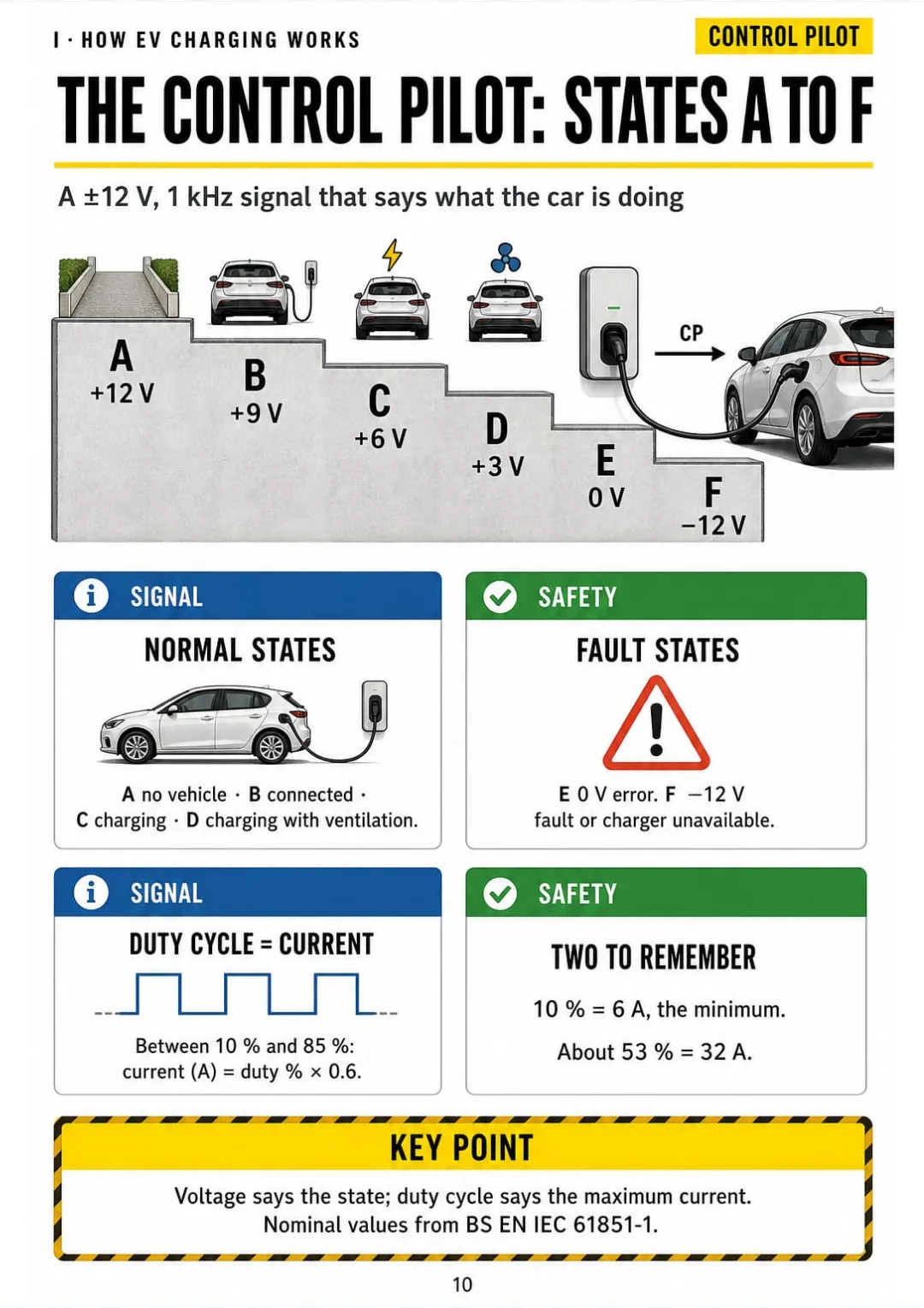
State A +12 V to F −12 V · current = duty % × 0.6 · 53 % ≈ 32 A.
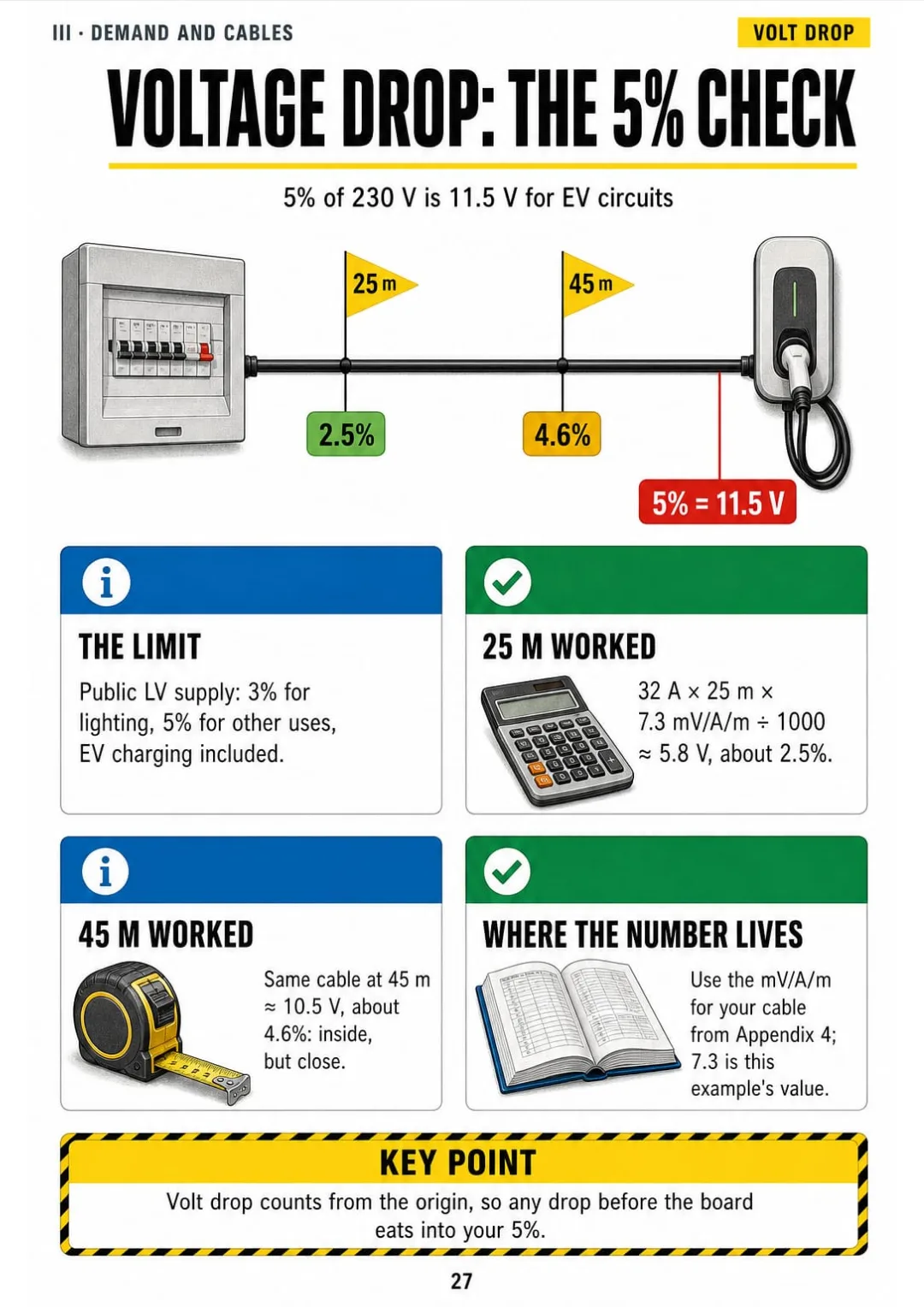
32 A over 25 m in 6 mm²: about 5.8 V, 2.5% of 230 V.
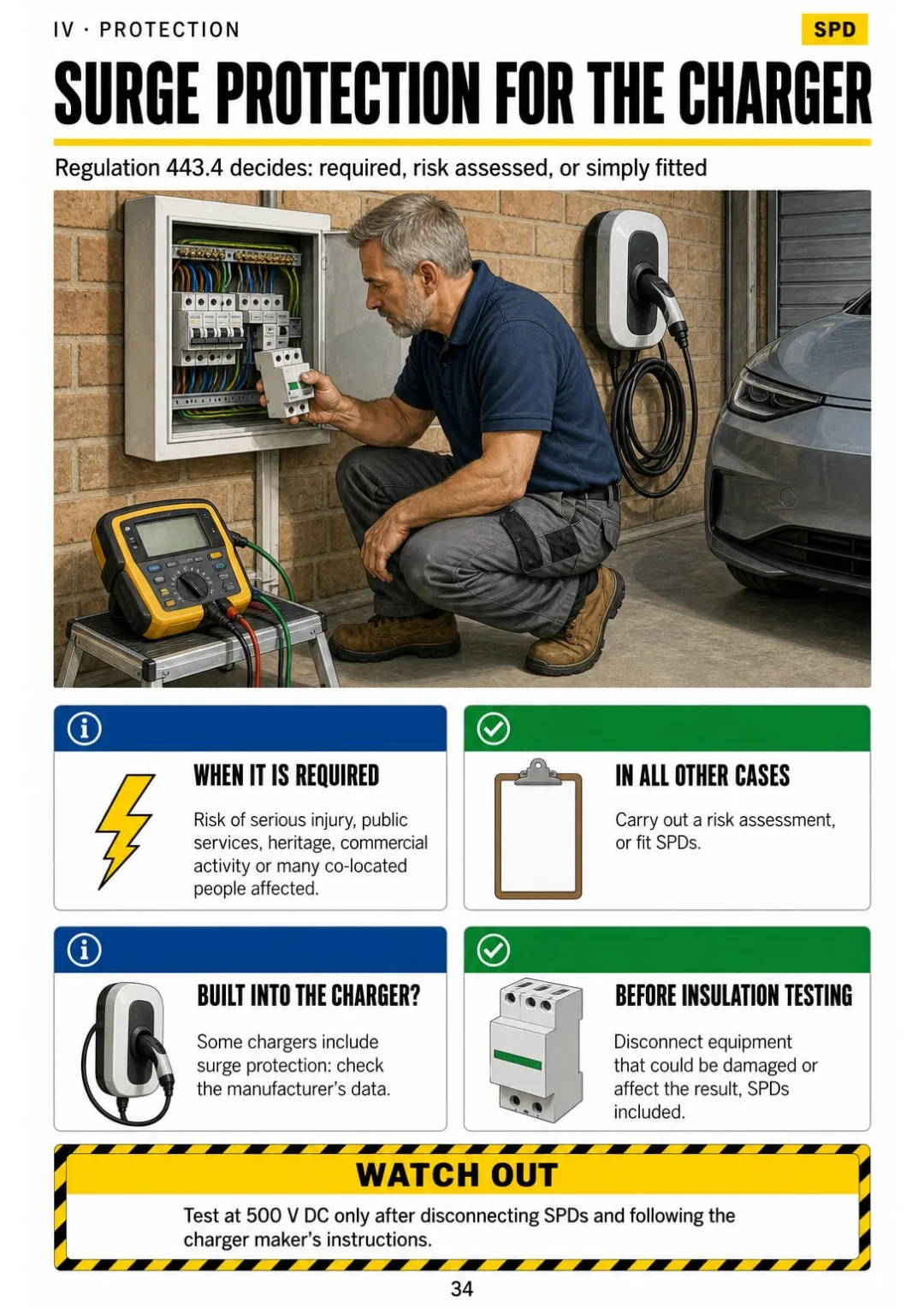
SPDs per Reg 443.4: required, risk-assessed or fitted, and disconnected before IR testing.
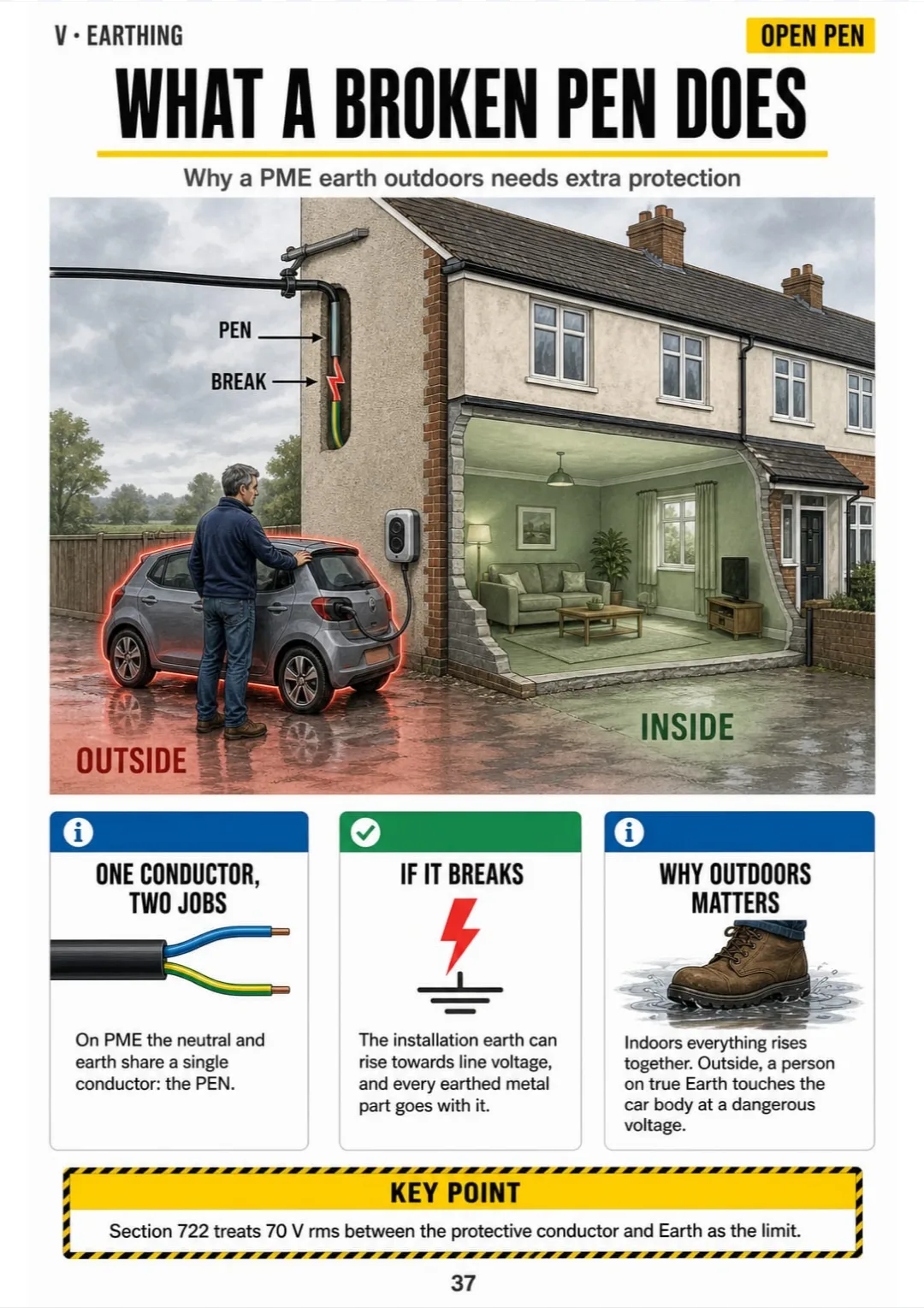
Broken PEN on PME: the car outdoors can sit near line voltage; 70 V rms is the limit
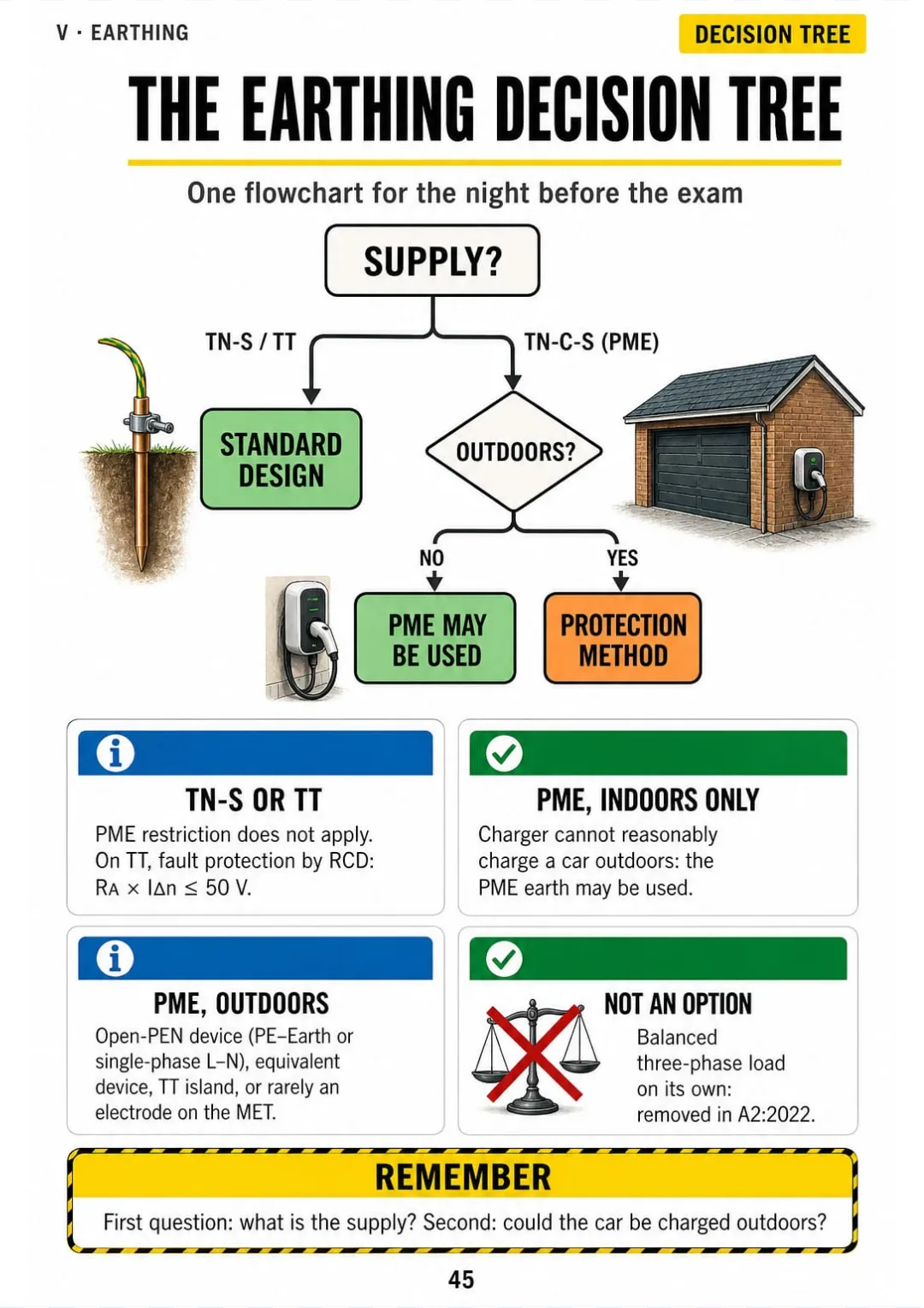
Supply type, then outdoors or not: the whole open-PEN decision on one page
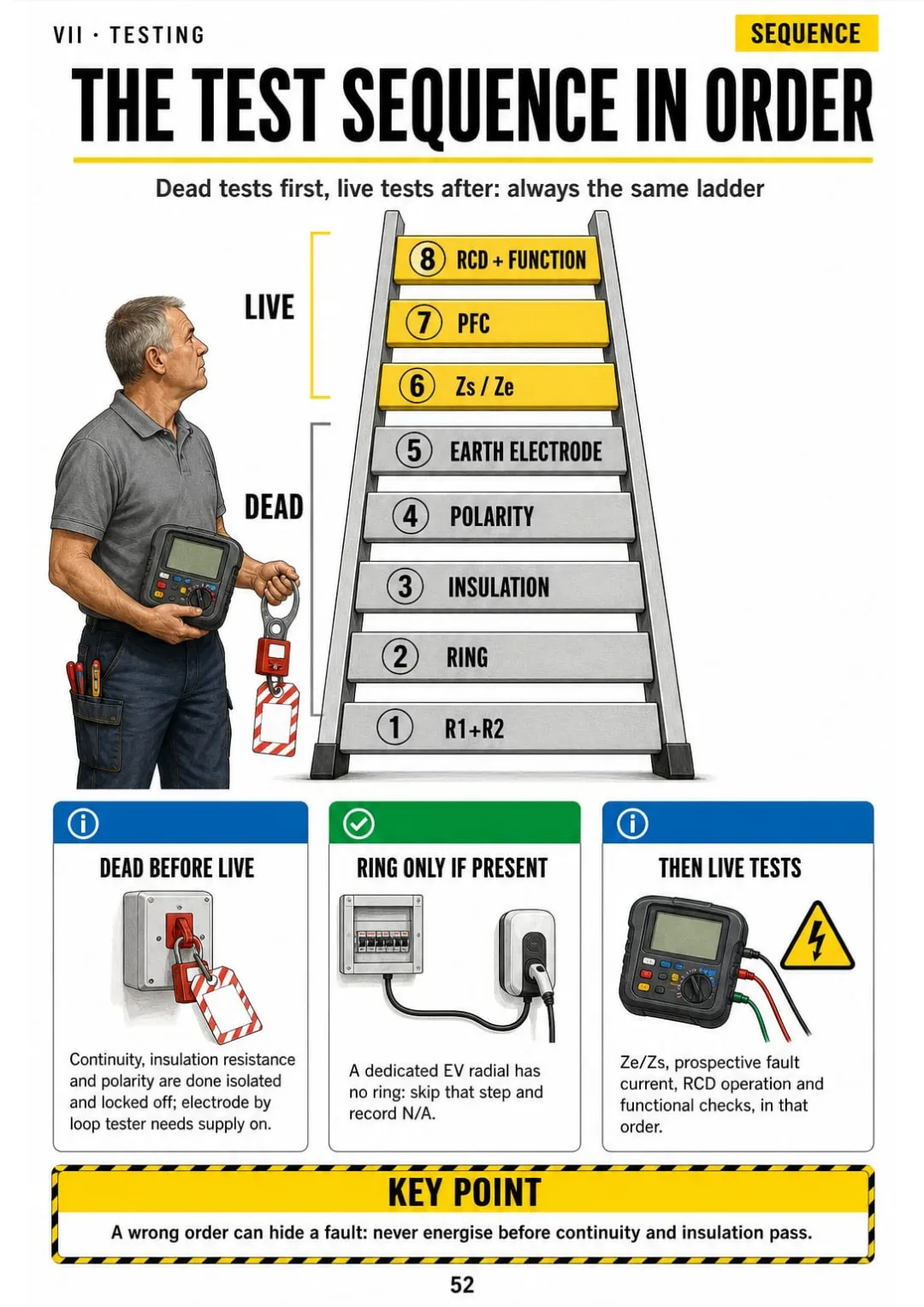
Dead tests (R1+R2, insulation, polarity, electrode) before live tests (Zs, PFC, RCD) – BS 7671 Part 6.
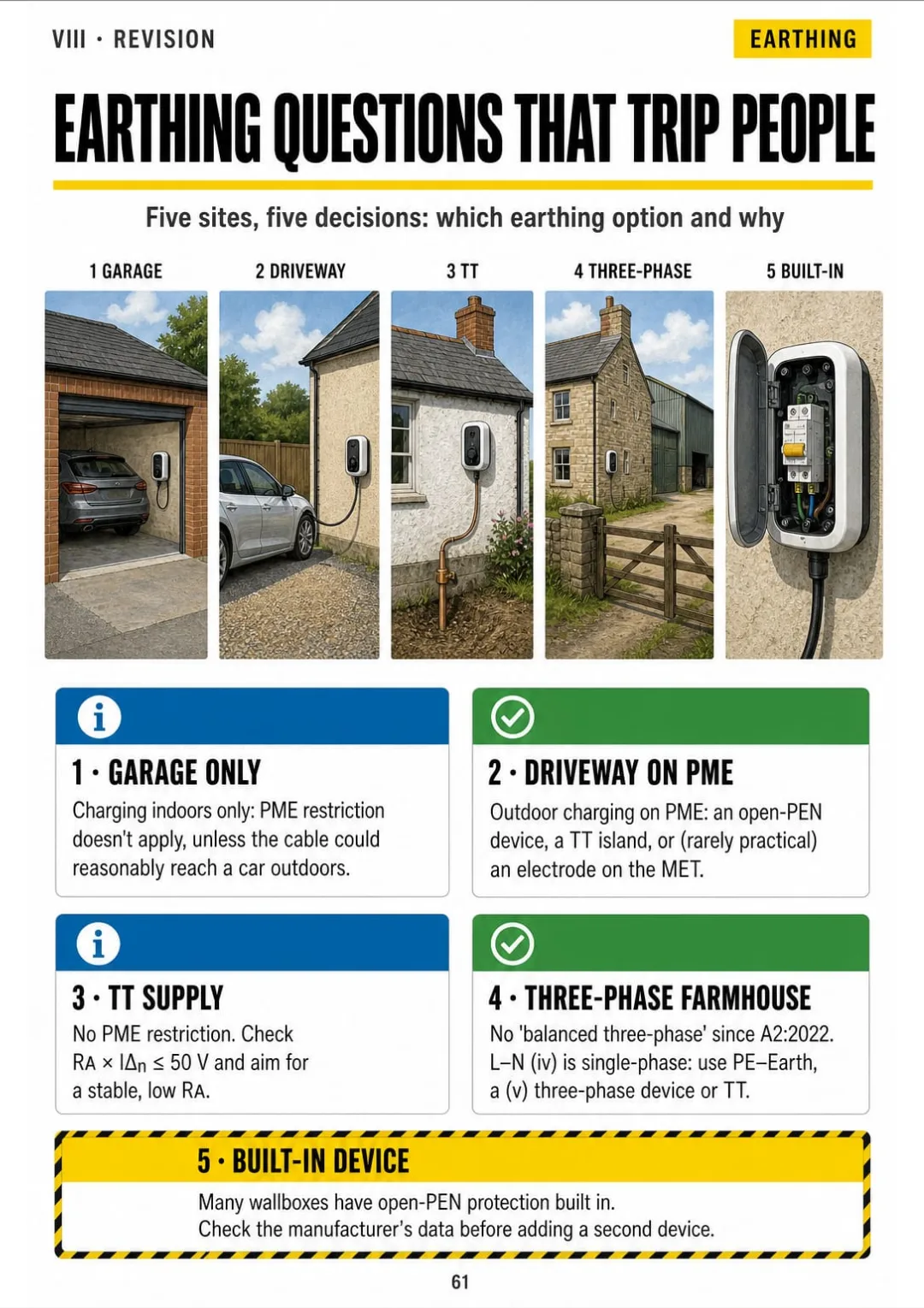
Garage, driveway, TT, three-phase, built-in device: the earthing option for each
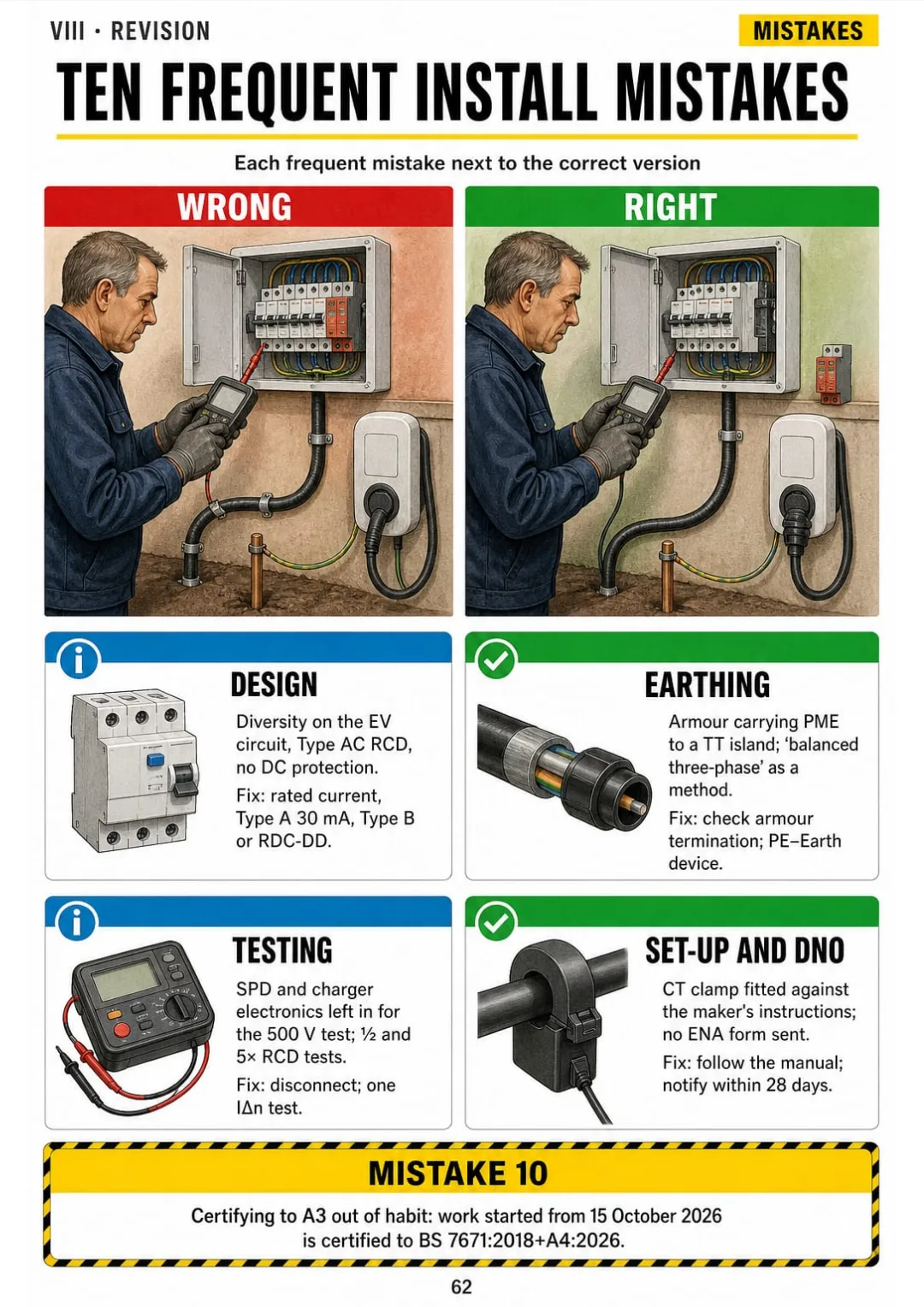
Diversity, Type AC, armour bridging PME to TT, SPD in the test… and the fix

Swipe to see more →

These are real pages from the book. The table of contents is the full one: 8 parts and 61 topics.

The Problem Isn't You. It's How It Was Explained to You.

You're filling in the design for a 7 kW wallbox on a driveway, and one question stops you: is the Type A RCD in the board enough, or does this charger need DC fault protection?

The Code of Practice answers it in paragraphs: smooth DC, residual current, 6 mA, RDC-DD, Type B, conditions and exceptions. You read it at ten at night after a day on the tools, and it just slides off.

SPDs per Reg 443.4: required, risk-assessed or fitted, and disconnected before IR testing.

In this book it's one page. Two routes drawn side by side: a Type B RCD on one, a Type A plus an RDC-DD tripping at 6 mA smooth DC on the other. You see which device does what, and where it sits.

The control pilot, voltage drop, the open-PEN decision and the test sequence work the same way: each one has its own page, drawn in the same order.

Next time the data sheet says 'RDC-DD built in', you know what it means for the board and you choose the RCD without going back to the manual.

COMPARE FOR YOURSELF

The Same Topic, Two Ways to Study It

THIS
  • The manual: line after line of small print
  • Voltage drop and cable sizing explained only in words
  • You get to the exam still unsure
When sizing the cable for a charge point circuit, the installer should take into account the design current, the length of the run and the voltage drop figure for the chosen cable, and should then compare the result with the limit that applies to the circuit, bearing in mind the installation method, the grouping with other cables, the ambient temperature and any thermal insulation along the route, each of which may require a correction factor to be applied before the final cable size can be confirmed and recorded.
FOR THIS
  • Voltage drop in one drawing
  • 32 A over 25 m on 6 mm²: 2.5%, in a highlighted box
  • You see it and it makes sense
32 A over 25 m in 6 mm²: about 5.8 V, 2.5% of 230 V.
CONTENTS

Take a Look at the 8 Parts and 61 Topics

How EV charging works, site survey and supply, maximum demand and cable sizing, protection, earthing and the open-PEN problem, installation on site, testing and certification, and revision with exam practice: 65 pages, all illustrated.

IHow EV charging works · pp. 5-12
  1. The 7-step design method
  2. Charging modes 1 to 4
  3. AC or DC: where the charger really is
  4. Connectors: Type 2, Type 1, CCS and CHAdeMO
  5. Power, current and charging time
  6. The control pilot: how car and charger talk
  7. The proximity pilot and cable rating
  8. Mode 2 on a household socket: the limits
IISite survey and supply · pp. 13-20
  1. The site survey in one walk-round
  2. Reading the cut-out and main fuse
  3. Identifying TN-S, TN-C-S (PME) and TT
  4. Checking the existing installation
  5. Measuring Ze and PFC at the origin
  6. Telling the DNO: connect and notify or apply first
  7. Choosing the charger position
  8. Smart charge point rules
IIIMaximum demand and cable sizing · pp. 21-28
  1. Maximum demand: the first number
  2. No diversity on the EV circuit
  3. Load management with a CT clamp
  4. Choosing the circuit and protective device
  5. Current-carrying capacity and installation method
  6. Correction factors in practice
  7. Voltage drop: the 5% check
  8. SWA, twin and earth or flex: which cable where
IVProtection · pp. 29-36
  1. Overcurrent protection for the EV circuit
  2. 30 mA RCD for every charging point
  3. DC fault protection: Type B or RDC-DD
  4. RCD types AC, A, F and B at a glance
  5. The upstream RCD trap
  6. Surge protection
  7. Isolation and switching
  8. Fed from the house or from a garage sub-board
VEarthing and the open-PEN problem · pp. 37-45
  1. What a broken PEN does to an outdoor car
  2. When the PME restriction applies
  3. Option 1: open-PEN protection device
  4. Option 2: a TT island for the charger
  5. The SWA armour trap on a TT island
  6. Three-phase supplies and voltage monitoring
  7. Sizing and installing the earth electrode
  8. Separation between PME and TT metalwork
  9. The earthing decision tree
VIInstallation on site · pp. 46-51
  1. Mounting the charge point
  2. Buried cable routes
  3. Through walls and inside the house
  4. Terminations and torque
  5. Wi-Fi, app and commissioning set-up
  6. Solar PV and load-managed homes
VIITesting and certification · pp. 52-59
  1. The test sequence in order
  2. Continuity and R1 + R2
  3. Insulation resistance without killing the charger
  4. Zs against the device limit
  5. Testing the earth electrode on a TT island
  6. RCD and DC protection tests
  7. Functional test with a test adaptor
  8. Certificate, notification and handover
VIIIRevision and exam practice · pp. 60-65
  1. The numbers on one page
  2. The earthing questions that trip people
  3. Ten most frequent install mistakes
  4. How to read a multiple-choice question
  5. Full design walkthrough: one real house
  6. Site checklist for the van

One Page, One Topic, All Clear

Think of it this way:

You're on a driveway with a PME supply, the customer is watching, and you have to decide how the charger gets its earth. No time to dig through the Code of Practice in the van.

In the book you open the earthing decision tree: supply type first, then outdoors or not, and every branch ends in a drawn option: open-PEN protection built into the charger, a separate open-PEN device, or a TT island.

Supply type, then outdoors or not: the whole open-PEN decision on one page

Maximum demand, voltage drop, DC fault protection, the control pilot and the test sequence work the same way: each one on its own page, with the key number highlighted.

EV Charging Installation Illustrated is 8 parts and 61 topics, all drawn, and it ends with the numbers on one page, a full design walkthrough of a real house and a site checklist for the van.

What you see drawn, you don't have to memorize.

What's Inside EV Charging Installation Illustrated:

Ipp. 5-12

How EV charging works

The 7-step design method, charging modes 1 to 4, AC or DC, connectors, power and charging time, the control pilot and proximity pilot, and the limits of Mode 2 on a household socket.

IIpp. 13-20

Site survey and supply

The site survey walk-round, reading the cut-out and main fuse, TN-S, TN-C-S and TT, Ze and PFC at the origin, telling the DNO, choosing the charger position and the smart charge point rules.

IIIpp. 21-28

Maximum demand and cable sizing

Maximum demand, why the EV circuit gets no diversity, load management with a CT clamp, the protective device, current-carrying capacity, correction factors, the 5% voltage drop check and which cable goes where.

IVpp. 29-36

Protection

Overcurrent protection, the 30 mA RCD, DC fault protection with Type B or RDC-DD, RCD types at a glance, the upstream RCD trap, surge protection, isolation and feeds from a garage sub-board.

Vpp. 37-45

Earthing and the open-PEN problem

What a broken PEN does, when the PME restriction applies, open-PEN devices, the TT island, the SWA armour trap, three-phase supplies, the earth electrode, separation of metalwork and the full decision tree.

VIpp. 46-51

Installation on site

Mounting the charge point, buried cable routes, going through walls, terminations and torque, app and commissioning set-up, and homes with solar PV or load management.

VIIpp. 52-59

Testing and certification

The test sequence in order, continuity, insulation resistance without damaging the charger, Zs against the device limit, electrode testing, RCD and DC tests, the functional test, and the certificate and handover.

VIIIpp. 60-65

Revision and exam practice

The key numbers on one page, the earthing questions that cause the most doubt, how to read a multiple-choice question, a full design walkthrough of a real house from survey to certificate, and the site checklist for the van.

At the end of the book: The key numbers on one page, a full design walkthrough of a real house and a site checklist for the van.
Plus: 2 Free Books

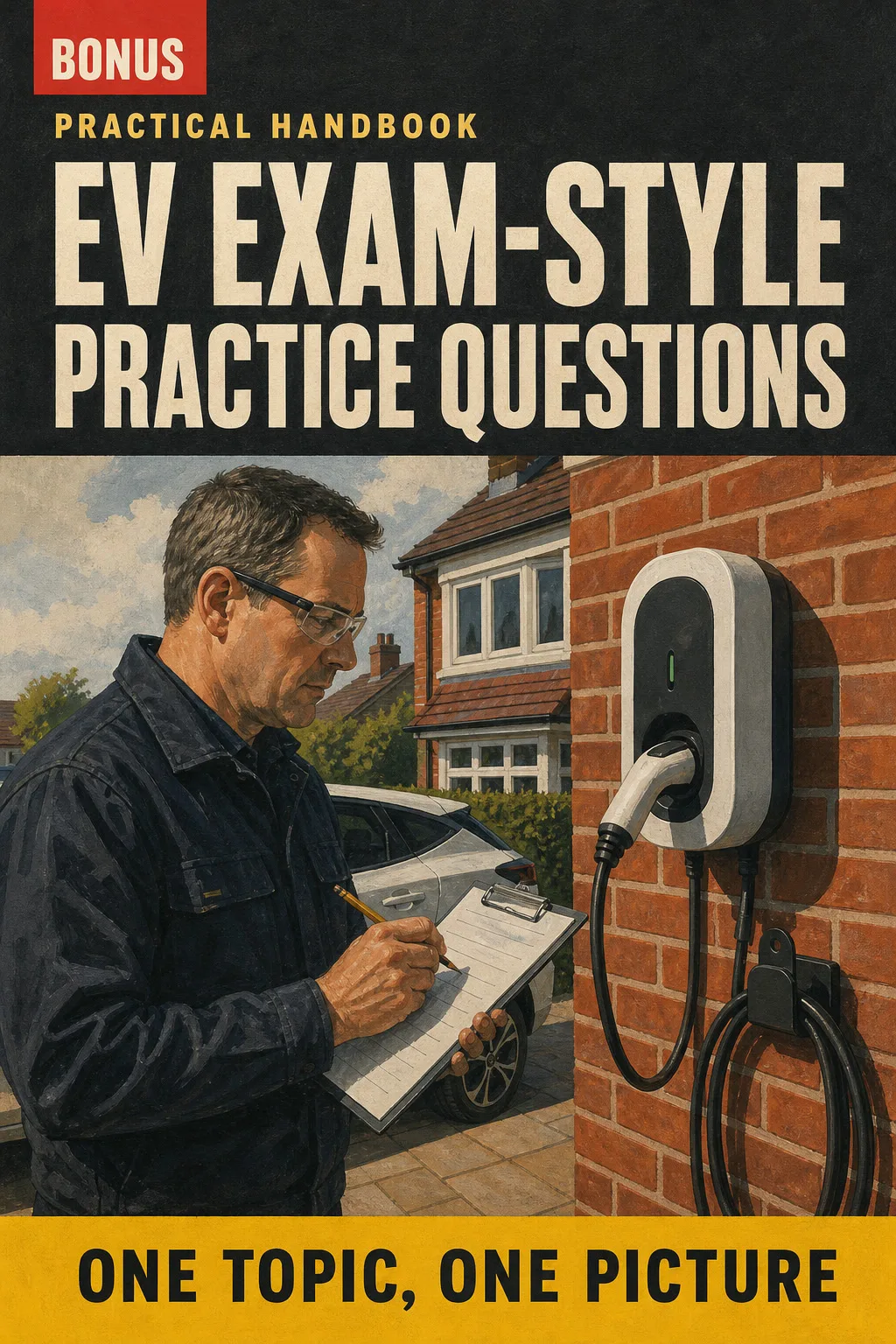
EV Exam-Style Practice Questions

BONUS 1: «EV Exam-Style Practice Questions»

Value on its own: US$ 17.90

Multiple-choice questions in the style of the online exam, each with the answer and the page that explains it, so you find your weak spots before the real thing.

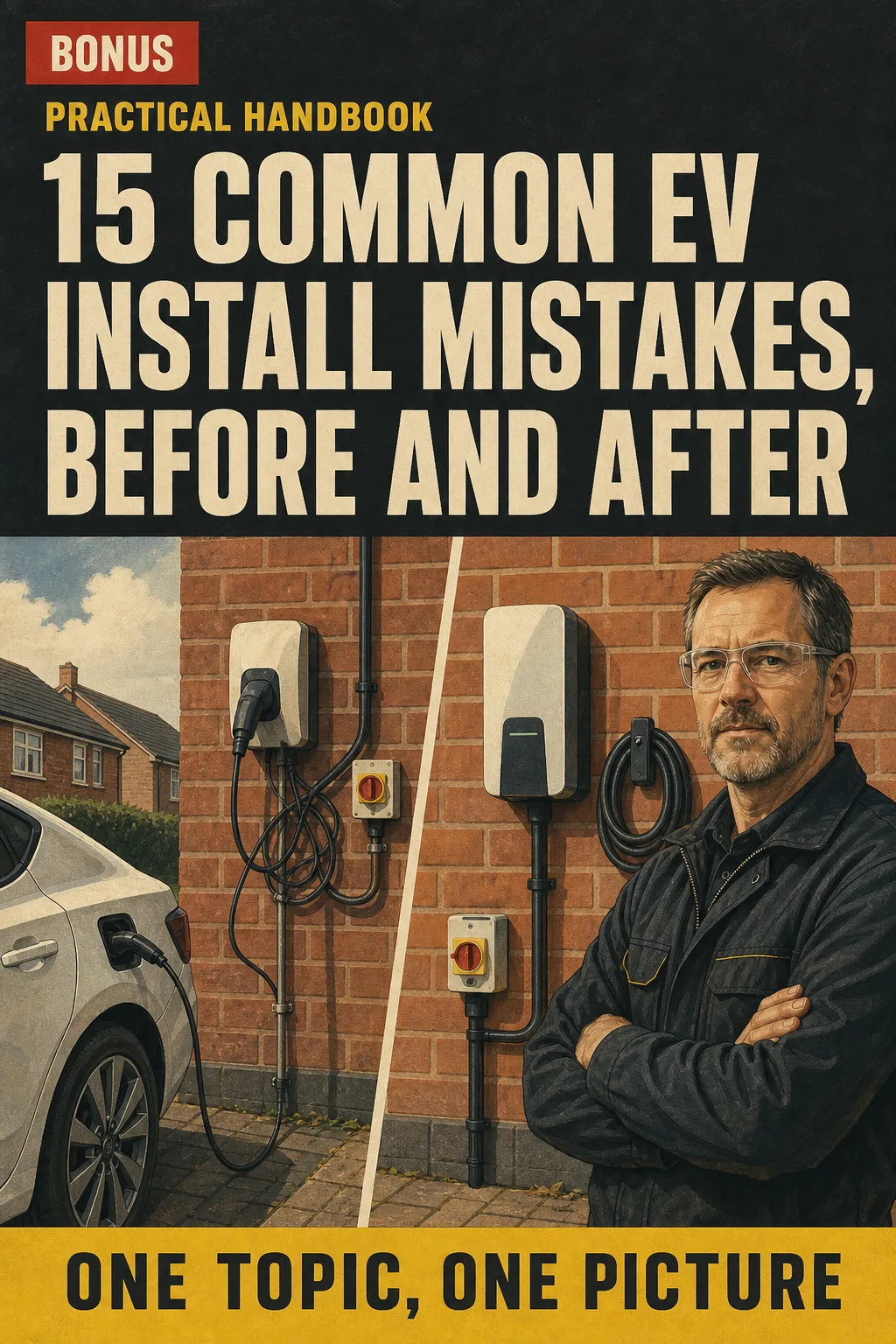
15 Common EV Install Mistakes, Before and After

BONUS 2: «15 Common EV Install Mistakes, Before and After»

Value on its own: US$ 14.90

The most frequent errors on charge point installs, each drawn wrong and then right, so you can revise them at a glance the night before or in the van.

EV Charging Installation Illustrated with 2 Free Books

  • EV Charging Installation Illustrated: 65 illustrated pagesUS$ 63
  • BONUS 1: EV Exam-Style Practice QuestionsUS$ 17.90
  • BONUS 2: 15 Common EV Install Mistakes, Before and AfterUS$ 14.90
  • High-resolution PDF to printIncluded
Total value US$ 95.80
YOUR PRICE:
US$ 27
You save US$ 68.80
YES, I WANT EV CHARGING INSTALLATION ILLUSTRATED FOR US$ 27

📄 This is a digital PDF book sent to your email: nothing is printed or shipped.

Secure purchaseEncrypted payment30-day guarantee

PDF by email: We email you EV Charging Installation Illustrated as a PDF, together with the two free books. It's a single payment: no installments, no extra charges.

Who This Book Is For

You're adding EV work to your trade

You're adding EV work to your trade

Every step of a charger install in the same order, from survey to certificate, with each decision drawn so it's still there after a long day on site.

Your 2921-34 exam is booked

Your 2921-34 exam is booked

The earthing options, the key numbers and the test sequence on pages you can revise in an evening, plus practice questions that send you back to the page that explains each answer.

You already fit chargers

You already fit chargers

A quick check on the calls that cause doubt: open-PEN earthing, DC fault protection, voltage drop on long runs. Printed, it lives in the van.

Everything You Get Today

US$ 95.80US$ 27
YES, I WANT EV CHARGING INSTALLATION ILLUSTRATED FOR US$ 27

📄 This is a digital PDF book sent to your email: nothing is printed or shipped.

30DAYS
GUARANTEE

30-Day Guarantee

Try EV Charging Installation Illustrated for 30 days, bonus books included.

We refund everything if the file won't open, if the book isn't what you see here, if you were charged twice or if the email doesn't arrive. Just email us.

You pay once. No subscriptions.

Frequently Asked Questions

Is it for me if I'm already a qualified electrician adding EV chargers to my work?

Yes. It's written for electricians who already work to BS 7671 and want the EV-specific part: supply assessment, open-PEN earthing, DC fault protection and testing. It doesn't explain what an RCD is from scratch.

Where does the content come from?

It's checked against BS 7671 Section 722 (the edition and amendments in force when it was written), the IET Code of Practice for Electric Vehicle Charging Equipment Installation and the Electric Vehicles (Smart Charge Points) Regulations 2021. The exact edition of each document is listed on the first page of the book, so you can compare it with yours. The explanations and drawings are our own; no text or tables from the standards are reproduced.

Is it official material?

No. It's independent study material, not affiliated with or endorsed by City & Guilds, the IET or BSI.

Does it replace the course or training?

No. It's a study book, not a course: it doesn't give you a certificate, a qualification or scheme registration. It helps you study and revise, but it doesn't replace approved training, the City & Guilds assessment or the competence you need to install, test and certify charge points.

Are the practice questions the ones in the exam?

No. They're written for this book in multiple-choice style and aren't official questions from any exam. Each one comes with the answer and the page that explains it.

When and how does it arrive?

The book and the 2 bonus books arrive as PDFs by email, to the address you enter at checkout. You can read them on your phone, tablet or laptop, or print them.

Do I have to pay every month?

No. It's a one-off payment, with no subscription.

Can I have it on paper?

Yes. It's a printable PDF: print it at home or at a print shop and keep it in the van.

How does the refund work?

You have 30 days. We refund everything if the file won't open, if the book isn't what you see on this page, if you were charged twice or if the email doesn't arrive: just email us.

Before You Close This Page

No more rereading with nothing sticking.

The open-PEN decision is drawn, and that's it.

You get to the exam knowing where everything is.

Drawings make studying faster.

The book is right below.

One-time payment: US$ 27 · Guarantee: 30 days · PDF by email

YES, I WANT EV CHARGING INSTALLATION ILLUSTRATED FOR US$ 27

📄 This is a digital PDF book sent to your email: nothing is printed or shipped.